Humanoids making humanoids: Schaeffler opens lighthouse factory in Taicang
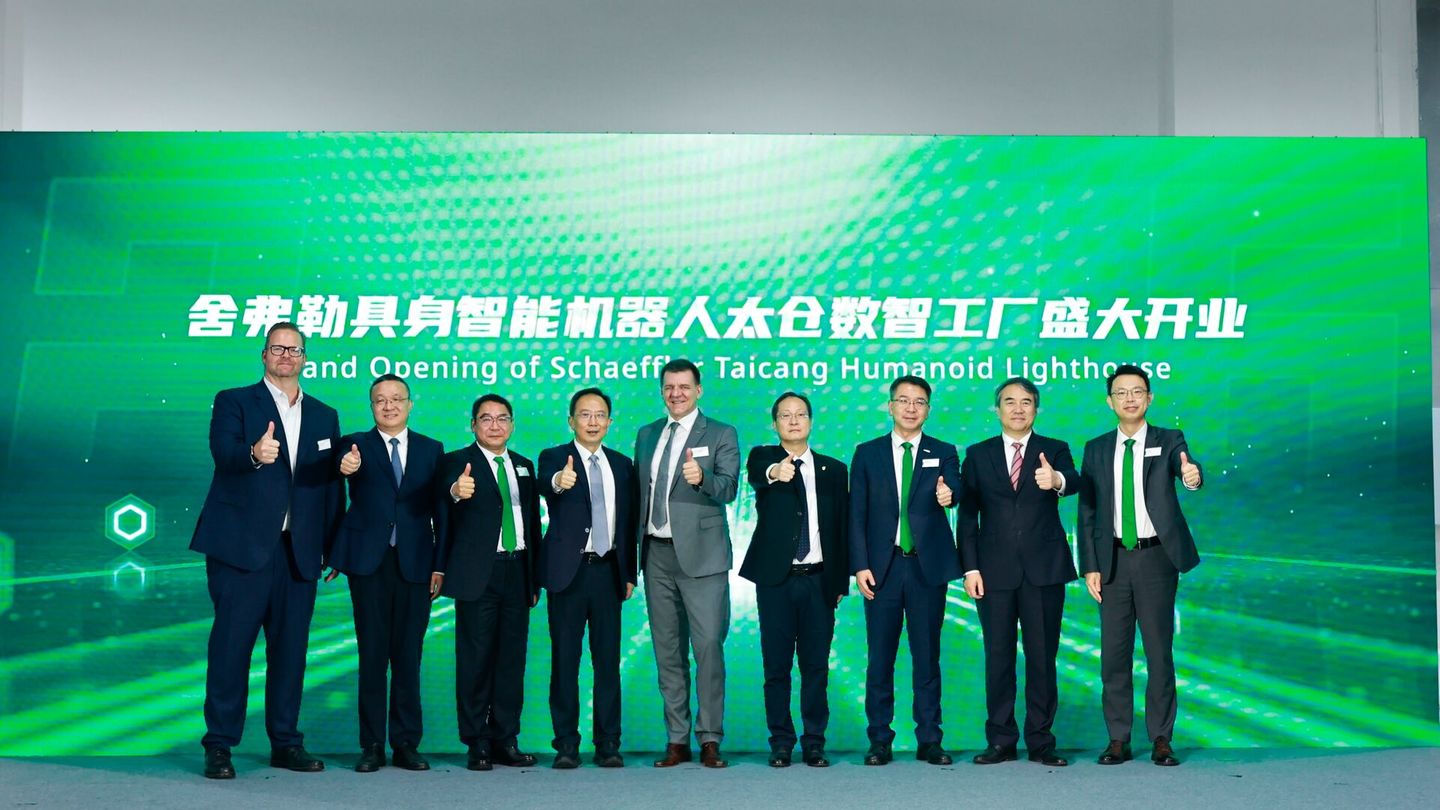
2026-10-20 | Taicang; China / Herzogenaurach, Germany
- Lighthouse factory in Taicang, China, brings together component manufacturing, robot training, data acquisition, and digital twins for industrial applications at one location
- Manufacturing of the future: Humanoids assemble joint modules at scale for next-generation humanoids
- Tests in actual manufacturing conditions accelerate industrial deployment of humanoid robots and create scalable product solutions
Motion Technology Company Schaeffler has opened a state-of-the-art lighthouse factory for humanoid robotics in Taicang, China. It houses an intelligent assembly line, a training and data acquisition center, a platform for digital twins, and a data center across approximately 7,500 square meters of floor space. The building covers the entire process from testing of individual robot skills to application in the actual manufacturing environment, showing what “humanoids making humanoids” looks like in practice: humanoid robots assembling key joint modules – including actuators – for the next generation of humanoid robots. The lighthouse factory marks the start of mass production of these components for Schaeffler and offers customers and partners the opportunity to train and test physical AI systems in actual industrial conditions. It therefore serves to drive adoption of humanoids in industry. Schaeffler’s business also reflects the booming demand in this growth field: The company recently announced the acquisition of two new customers from the Greater China region in Q3 2026. With this, global incoming orders for humanoid robotics rose to some 400 million euros.
Dr. Jochen Schröder, Chief Operating Officer of Schaeffler AG, says: “Schaeffler wants to shape the production of the future and become a leading supplier and preferred technology partner for humanoid robotics. With the lighthouse factory in Taicang, we are creating something that has never before been seen in Schaeffler’s global network: a closed manufacturing loop where humanoids assemble components for humanoids. In the lighthouse factory, we combine decades of manufacturing expertise with physical AI and digital twins. With it, we are expanding our capabilities for key robot components and taking humanoid robotics from theory to industrial practice.”
From component manufacturing to industrial application
At the heart of the lighthouse factory is an assembly line developed by Schaeffler for key components of humanoid robots, including linear and rotary actuators. Six humanoids work together at five stations. They stage and sort parts, join them, and inspect, label, and package them. A digital twin acts as a virtual replica that mirrors the actual line processes in real time. Sensors record parameters such as assembly accuracy, individual work step duration, energy consumption, and asset condition. Changes can be digitally tested and optimized before being implemented in the actual manufacturing processes. This leads to significantly shorter development times and more stable and reliable production.
At the same time, Schaeffler trains humanoid robots for industrial tasks in the training and data acquisition center. Tasks include visual inspection of parts, packaging, material handling/transport, container moving, and line-side material replenishment. The training environments are oriented toward the actual conditions in Schaeffler’s approximately 100 manufacturing plants. This means that the learned skills can be tested and fine-tuned right on the assembly line. Robot performance is continuously improved through the use of linked data from training, simulation, and production.
Dr. Yilin Zhang, Regional CEO Greater China at Schaeffler, says: “China’s humanoid robotics industry is entering a fast growth period. As a motion technology company, Schaeffler is accelerating the development of China’s humanoid robotics ecosystem by leveraging its local capabilities in research and development, manufacturing and industrial collaboration. The opening of the Taicang lighthouse represents another important move in Schaeffler’s long-term commitment to China and business development in humanoid robotics.”
A short video offering exclusive insights into the interior of the new Lighthouse Factory can be found at the following link:
https://www.youtube.com/watch?v=Ef_yPULR0fM
Publisher: Schaeffler Technologies AG & Co. KG
Country: Germany
Terms of use for Schaeffler press pictures
Schaeffler press pictures may only be used for editorial purposes. Unless otherwise stated, all copyrights and rights of use and exploitation are owned by Schaeffler Technologies AG & Co. KG, Herzogenaurach (Germany) or by one of its affiliated companies. The reproduction and publication of Schaeffler press pictures is only permitted if the source is stated as follows: "Image: Schaeffler". The pictures may be used free of charge in such cases. The use of pictures for advertising or other commercial purposes, in particular their disclosure to third parties for commercial purposes, is hereby prohibited. Pictures may only be edited with the approval of Schaeffler.
We kindly request that a specimen copy be sent to us when Schaeffler press pictures are published in printed media (or a digital copy in the case of publication in electronic media). When using Schaeffler press pictures in films, please notify us and state the title of the film.
Use and utilization of Schaeffler press pictures is subject to the substantive laws of Germany without its conflict of law provisions. The place of competent jurisdiction shall be Nuremberg, Germany.
Postal address:
Schaeffler Technologies AG & Co. KG
Corporate Communication
Industriestrasse 1-3
91074 Herzogenaurach
Germany
Press releases
Package (Press release + media)