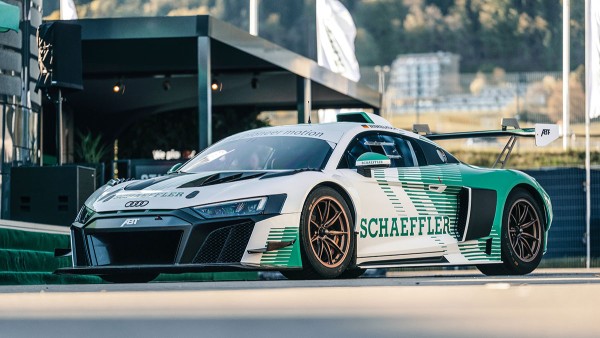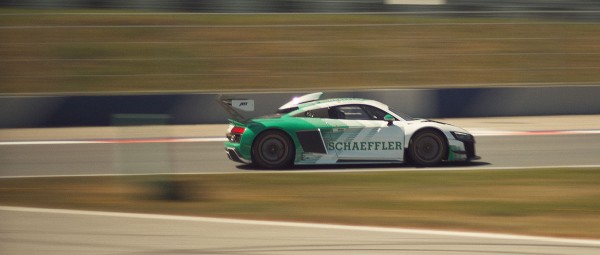
Premiere: Schaeffler rear-wheel steering in a GT racing car for the first time
During the 2024 DTM season, the Schaeffler Innovation Taxi presented a true pioneering achievement and brought to life just how closely motorsport and series development are linked in the company. It was the first touring sports car to line up with rear-wheel steering.
The Schaeffler system made its debut in production vehicles in 2023. One year later, a test drive in the Schaeffler Innovation Taxi showed that its technological edge has a positive effect on both the road and the racetrack.
The planetary roller gear sets the Schaeffler rear-wheel steering apart from other manufacturers’ systems, which traditionally use a trapezoidal screw drive. While trapezoidal screw drives use spindles, the Schaeffler system uses rollers, also known as "planets", as rolling elements. It thus combines the technology of a rolling bearing with that of a planetary gearbox. This leads to numerous advantages: Among other things, in the car the Schaeffler innovation achieves a significantly higher level of efficiency, is lighter and reduces friction as well as the reaction time of the system.
The rear axle can steer both parallel and in the opposite direction to the front axle.
Winkelhock: Schaeffler system has “clear advantages on the track”
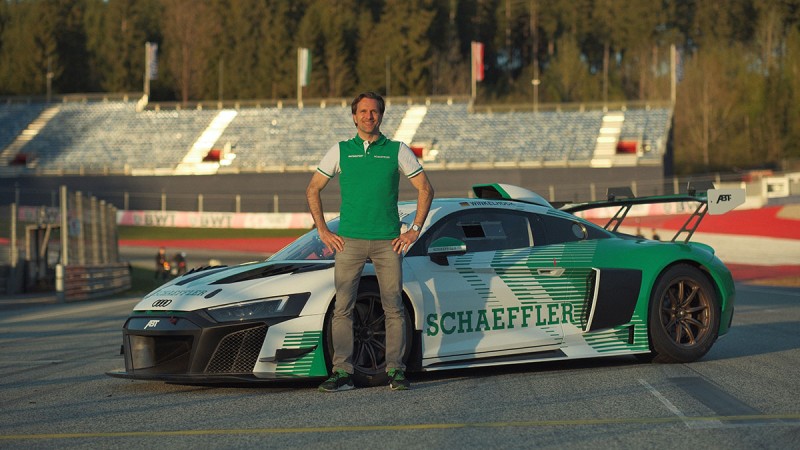
The new steering system for the rear axle makes vehicles easier to handle in city traffic, more stable when changing lanes, and more manoeuvrable when parking. At the racetrack the system makes the vehicle more agile at lower speeds, such as when accelerating out of narrow bends. Since the rear wheels steer in the opposite direction to the front wheels, the race taxi turns the right way into the corner exit earlier on, which facilitates earlier acceleration. When the rear wheels steer in the same direction as the front wheels, the rear-wheel steering stabilises the vehicle. This prevents oversteer and enables corners to be negotiated faster and more safely.
In summary: The vehicle becomes easier to drive, is easier to control, and enables potentially faster laps. In addition, the Schaeffler system leads to slower tyre degradation and enables chassis tuning with greater mechanical traction. Markus Winkelhock was impressed after his first drive with the rear-wheel steering system: “You can really feel the effect of the rear-wheel steering. The car is much easier to manage, particularly in hairpin bends and when accelerating out of turns. This has clear advantages on the track.”
May 2026