Schaeffler continues to strengthen its position as system partner to the wind power industry
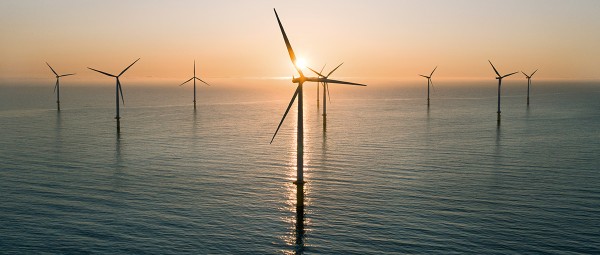
The global wind power industry is growing faster than many expected – with increasingly larger rotors, higher nominal power, and increasing requirements for reliability. This is putting the sector under pressure to innovate and calls for a forward-looking commitment to research and development.
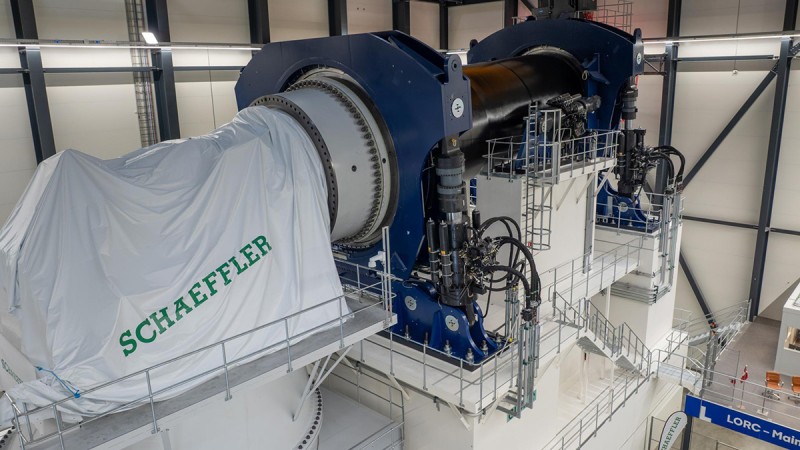
With the commissioning of the world’s most powerful test facility for rotor bearings in Lindø, Denmark, the Motion Technology Company Schaeffler is underpinning its role as a system partner to the industry and helping customers to develop offshore projects with turbine nominal power up to 25 MW.
The test rig enables rotor bearings to be tested realistically under extreme offshore conditions. In this way, Schaeffler ensures that Original Equipment Manufacturers can validate their products in the complete main bearing assembly more quickly, minimize technical risks, and make wind turbines more reliable and cost competitive. This is a crucial step in meeting the global demands for sustainable and efficient wind energy.
Innovation on the scale of the future
When the massive rotor blades of an offshore turbine turn in the wind, there are enormous forces acting on each component. The capabilities of modern engineering are especially apparent in the heart of the machine, the drivetrain. This is the location for the rotor bearing – a key component weighing several tons that absorbs forces and moments caused by the wind. With rotor diameters of up to 300 m, these loads reach extreme magnitudes and represent the ultimate test for material, design, and engineering capabilities.
Rotor bearings are among the most critical components of a wind turbine, as their failure generally results in long downtimes and high maintenance costs. The most relevant causes of rotor bearing failure are related to the interaction between the bearing and the surrounding components in the drive train system. To avoid such scenarios, tests need to be conducted under realistic operating conditions. These tests not only include the rotor bearing itself but also the main bearing housing and shaft system. And that’s exactly why the new test facility was developed in cooperation with the Lindø Offshore Renewables Center (LORC) and R&D Test Systems. The test rig simulates the forces acting on rotor bearings in offshore wind conditions, creating the basis for even more efficient and reliable systems.

Data brings reliability – reliability allows progress
The test rig is not a one-off test module but part of Schaeffler’s integrated closed loop engineering approach. System simulations, realistic test rig tests, and field validations dovetail with one another to create a seamless development process. In line with this closed-loop approach, all insights gained flow directly back into product development – for even more precise, reliable and efficient solutions.
This creates a development process that combines efficiency and reliability: Robust parameters shorten development times while improving the reliability of future bearing solutions. “With projects such as this one in Lindø we are demonstrating that as a Motion Technology Company, Schaeffler is setting benchmarks and systemically expanding its technological leadership,” says Bernd Endres.
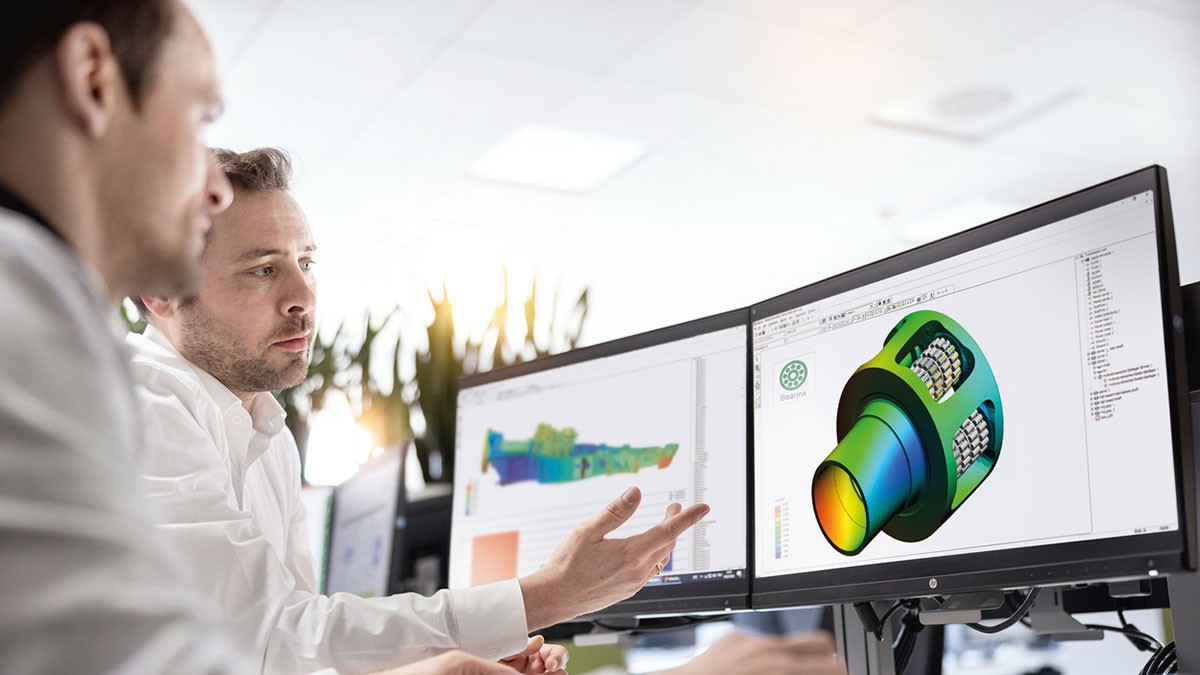
The closed-loop approach covers the entire development cycle – from the virtual model to the validated solution in real-life operation. For customers, this means predictable processes, shorter development times, and greater operational reliability.
Collaboration as the key to progress
As is the case in Lindø, these kinds of technological advances only come about when collaborating closely with strong partners. For the new test rig, Schaeffler worked closely with experienced test facility operator LORC and with R&D Test Systems, an internationally renowned developer of test rigs for the wind power sector.
A test rig that advances wind power
With the new test rig in Lindø, Schaeffler is reinforcing its position as a reliable system partner to the wind power industry and creating the basis for the development and validation of next-generation wind turbines.
For the sector, this means faster validated innovations, optimized cost structures, and reduced technical risks. Operators benefit from more reliable systems, longer life cycles, and a much-reduced potential for failure. The test rig is therefore a key component for making wind power even more cost efficient, reliable and future-proof – in collaboration with customers and partners.
February 2026